

How to Buy Chanel: Models, Leathers, Sizes & Pre-Owned Value
There’s a reason the Chanel flap is the bag people save for. It’s instantly recognizable; it has held its value for decades, and — unlike almost any other handbag — it has spent the last ten years getting more expensive like clockwork. A medium Classic Flap that cost around $5,000 in 2016 now retails for over $11,000 in 2026. That single fact reshapes how anyone should think about buying Chanel today.
This guide covers what you actually need to know before you buy: the core models worth knowing, how to choose between caviar and lambskin, what drives long-term value, and why, for many buyers, the pre-owned market is now the smartest way in.
Why Chanel Prices Keep Climbing
Chanel’s pricing is not accidental. The brand has raised retail prices repeatedly, often more than once a year, as a strategy to reinforce exclusivity and push the brand further up the luxury hierarchy. The 2.55, first sold in 1955 for $220, and the Classic Flap, introduced in 1983 at around $1,000, now both sit above $11,000 in their medium size. But most of that climb is recent: a roughly 140% increase in just the last decade, driven by repeated price hikes that show no sign of slowing.
The effect is that a “starter” Chanel is no longer a starter price. Even smaller pieces and core styles have climbed steadily, and each increase resets the floor for everything beneath it. For buyers, this changes the math in two ways: it makes the timing of a purchase matter, and it makes the secondary market — where you can often find a bag in excellent condition at or below current retail — genuinely compelling rather than simply cheaper.
Chanel Bag Styles: Classic Flap, Boy Bag, 2.55, and More
Where Hermès is defined by leather and size, Chanel is defined by model. Knowing the lineup is the foundation of buying well, because the silhouette is what drives both desirability and resale.
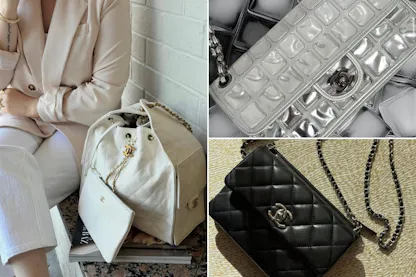
Classic Flap / Double Flap. The anchor of the entire brand — diamond quilting, leather-laced chain strap, and the CC turn-lock closure. The Double Flap (two interior flap compartments) is the version most buyers picture. It is the most recognizable, most liquid, and most investment-grade bag Chanel makes.
2.55 Reissue. The original 1955 design that started it all, distinguished by the rectangular “Mademoiselle” lock and an all-metal chain. More understated and more historically minded than the Classic Flap, the choice of buyers who want the purist version.
Boy Bag. Introduced in 2011, the Boy trades soft quilting for architectural lines, a boxy frame, and a chunky push-lock. It reads more modern and more structured, and it’s a strong entry point with current pre-owned pieces currently starting around $4,400.
Chanel 19. The newest pillar of the lineup — oversized quilting, a mixed-metal chain, and a slouchier, more relaxed body. It’s the contemporary flap for someone who finds the Classic too formal.
Wallet on Chain (WOC). The most accessible way into Chanel: a slim flap on a chain, worn crossbody or as a clutch. Often the first Chanel a buyer owns, with pre-owned examples starting around $2,000 and up.
Totes. The Deauville, Grand Shopping Tote, and Cambon line offer Chanel’s identity in a roomy, everyday format — ideal for buyers who want the brand for work or travel rather than evening.
Hobos, bowlers & crossbodies. Beyond the icons, Chanel’s broader range — the Chanel 22, hobo silhouettes, top-handle and messenger styles — rounds out the options for buyers who prioritize how a bag is carried over collecting a specific classic.
Across all of these, you’ll find caviar and lambskin leathers, tweed, denim, jersey, and special-edition finishes, in a spectrum of neutrals and seasonal colors. The full range rotates constantly — browse the current pre-owned Chanel selection to see what’s available now.


Chanel Caviar vs. Lambskin: Leather, Hardware & Sizes
Once you’ve chosen a model, three decisions shape the bag you actually carry.
Caviar vs. lambskin is the most important call. Caviar — Chanel’s pebbled, textured calfskin — is durable, scratch-resistant, and forgiving through daily use, which makes it the practical choice and a consistently strong resale leather. Lambskin is buttery, luminous, and unmatched for depth of color, but it scuffs and shows wear far more readily. The rule of thumb: caviar for a bag you’ll use hard, lambskin for a piece you’ll treat carefully and love for its finish.
Hardware comes in gold, silver, and ruthenium (a darker, gunmetal tone). Gold and silver on classic black are the safest for resale; seasonal or aged-hardware treatments can be beautiful but slightly narrow in the future buyer pool.
Sizes run Mini, Small, Medium (the “Classic”), Jumbo, and Maxi. The Medium is the sweet spot — the most versatile proportion and the strongest resale size — fitting a wallet, phone, and the essentials. Small and Mini have surged in popularity and price; Jumbo and Maxi offer presence and capacity but sit slightly behind the Medium on demand.

You Can’t Just Add One to Cart
Here’s what surprises most first-time buyers: you cannot buy a Chanel handbag online. The brand’s website displays its bags beautifully, but there’s no checkout — every product page simply points you to your nearest boutique and invites you to book an appointment. What’s shown online is only a seasonal selection, too, not the full range; to see most of what Chanel makes, you have to walk in.
And walking in comes with its own rules. Boutiques carry limited stock of the classics; popular colors and sizes sell out quickly. Buyers are capped at one Classic bag per year, a policy designed to keep resellers from clearing the shelves. Sought-after pieces often mean a waitlist or a return trip.
None of this is an accident. The same scarcity that makes the boutique experience feel exclusive is what pushes so many buyers toward the secondary market — where the bag you want, in the leather and color you want, is in front of you and available now.
Chanel as an Investment
Few handbags can be discussed in genuine investment terms, and the Classic Flap is one of them. As Chanel has pushed retail prices up, resale values have followed — secondary-market reporting has tracked Classic Flap resale prices rising sharply over the last five years, with the most sought-after flap styles retaining close to their full value over time. Pristine bags bought a few years ago routinely resell for at or near what the owner paid.
The pattern is self-reinforcing: higher retail prices pull more value into the resale market, which in turn supports further retail increases. That feedback loop is exactly why a well-chosen Chanel behaves more like a semi-financial asset than an ordinary accessory.
What holds value best is consistent: the Classic Flap and 2.55 in caviar, in core colors like black and beige, in small and medium sizes. As with any collectible, condition and completeness matter — a bag with its authenticity card, dust bag, and box commands more than the same piece sold alone; condition matters even more on delicate lambskin than on caviar.
Why Pre-Owned Is the Smart Way to Buy Chanel
For most buyers today, the secondary market is the most sensible path to owning Chanel. The advantages are real:
Value against rising retail. Because retail prices have climbed so steeply, a pre-owned bag in excellent condition is often available at or below the current boutique price — and an older piece may have been made when the same model cost thousands less.
Access to what you can’t buy new. Discontinued colors, vintage flaps, seasonal materials, and limited editions exist only on the secondary market. For collectors, this is where the most distinctive pieces live — a vintage flap with character, a pastel that was produced briefly and disappeared.
No markup, no wait. You choose the exact model, leather, color, and hardware you want, and buy it on your timeline — with full transparency on condition before it arrives.

How to Authenticate a Pre-Owned Chanel
Counterfeit Chanel exists at every price point, and the best fakes are sophisticated. Whether you’re buying from a reseller or a private party, authentication is non-negotiable.
What to look for in any seller’s process:
- Independent, technology-backed verification. The most credible retailers use third-party authentication technology rather than relying on in-house review alone. Entrupy — the leading AI-powered authentication platform — uses microscopic imaging to analyze materials at a level no visual inspection can match, and guarantees every piece it certifies.
- In-house specialist review. Technology should be paired with trained eyes. A thorough Chanel inspection covers quilting alignment, stitching, the weight and finish of CC hardware, the turn-lock mechanism, serial-number stickers and authenticity cards, heat stamps, and interior construction.
- Condition documentation. Authenticity and condition are separate questions. Look for high-resolution photography of corners, the chain, hardware, interior lining, and strap wear — not just glamour shots — plus written condition notes.
- An authenticity guarantee. A credible seller stands behind its process: if a piece is independently verified as inauthentic, you receive a full refund. That guarantee is what separates a documented process from a promise.
How The 1916 Company authenticates Chanel
Every Chanel handbag we offer goes through a two-step process. First, each bag is independently verified using Entrupy’s AI-powered authentication technology, which provides a financial guarantee on every piece it certifies. Second, our in-house specialists conduct a detailed review — quilting, stitching, hardware, serial numbers, stamping, and interior construction — to confirm both authenticity and the accuracy of our condition assessment. Every bag is then presented with high-resolution photography and detailed condition notes before it’s listed.
Shopping Pre-Owned Chanel at The 1916 Company
The 1916 Company carries a curated selection of authenticated pre-owned Chanel handbags across models, leathers, sizes, and colors — each condition-graded with notes and photographs, so you know exactly what you’re buying before it arrives. Our Client Advisors can help you compare sizes, weigh caviar against lambskin, and understand how color, hardware, and vintage-versus-current production affect long-term value.
And if you have a Chanel to sell, our Sell & Trade program makes it simple: submit the details, receive a quote, ship the bag, and — once we’ve verified authenticity and condition — you’re paid.
*Source: This Is Why Chanel Has Implemented A One-Bag-Per-Year Policy